
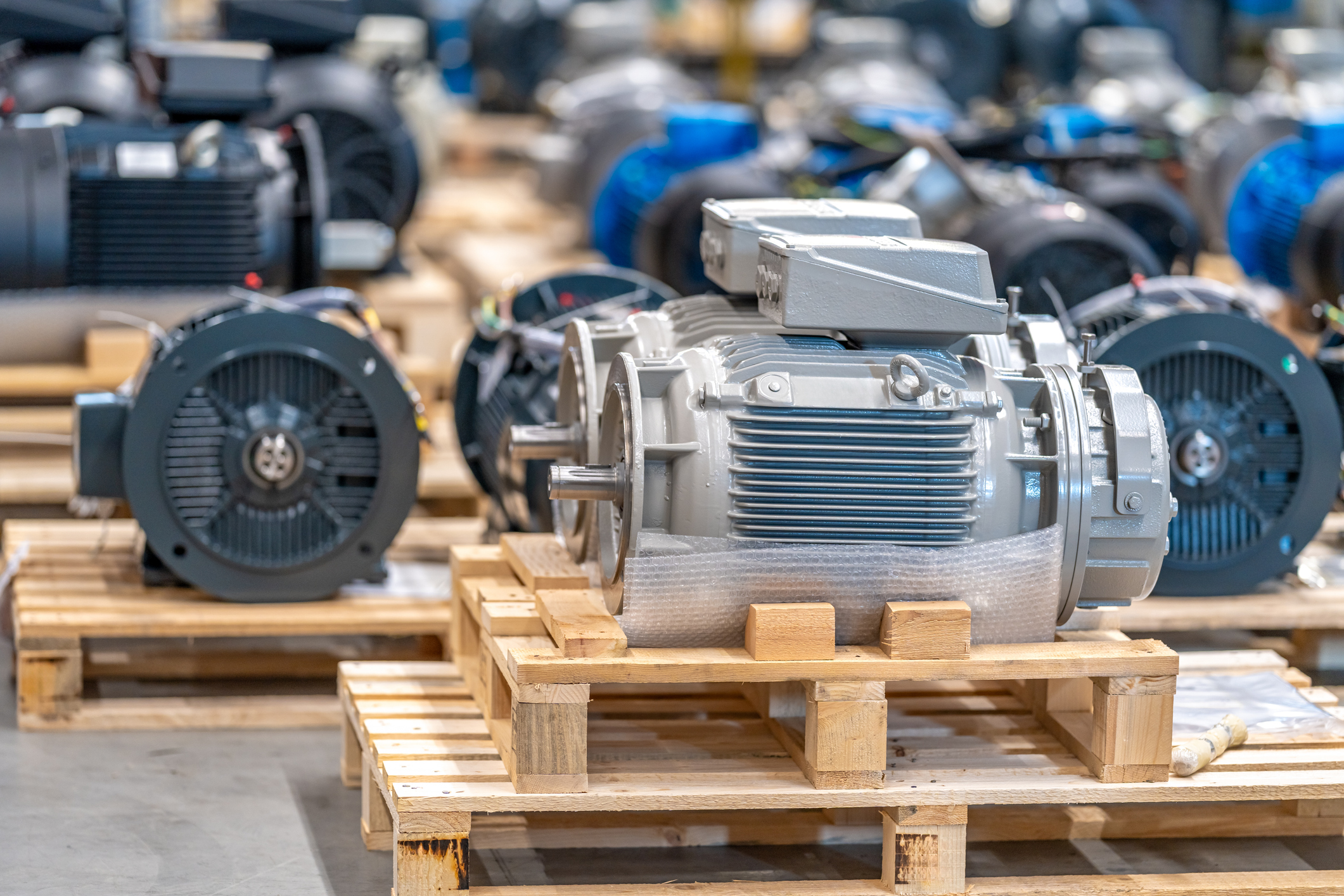
How to Choose the Right Electric Motor for Your Application
Selecting the right electric motor goes beyond matching horsepower to load. Duty cycle, enclosure type, efficiency rating, operating environment: all of these affect how long that motor will last and how much it'll cost you over its lifetime.
I've seen plenty of motors fail prematurely, and not because they were bad motors. They were the wrong motor for the application. A motor rated for clean, dry, indoor conditions won't survive a washdown environment. A motor sized for continuous duty will overheat in a high-cycling application.
Here are the decision points every plant engineer should think through.
Start with the load requirements
Before you open a motor catalog, define what the motor actually needs to do.
Horsepower and torque
Calculate the actual load requirements, not just what the old motor was rated for. Production lines change over the years. Loads get added. Speeds get adjusted. The original motor spec may no longer match actual demand.
For conveyors, the variables that matter are belt speed, belt tension, and material weight. For pumps, it's flow rate and head pressure. For fans, cubic feet per minute and static pressure.
If you're replacing an existing motor, measure the actual current draw under full load. If the motor consistently runs at less than 50% of its rated load, it's oversized. You're paying for capacity you don't need and operating at lower efficiency. If it's running above 100% service factor, it's undersized and headed for a short life.
Speed
Most standard motors run at 1800 or 3600 RPM (on 60 Hz power). If your application needs a different speed, you have options:
- Gear reduction: a gearbox or gear motor provides fixed speed reduction with high torque multiplication. Best for constant-speed applications.
- Variable frequency drive (VFD): lets you adjust motor speed electronically. Good for conveyors running different products, fans adjusting to demand, or anywhere speed needs to change.
- Multi-speed motors: less common now, but still used in some applications. Two or more fixed speeds available through winding configuration changes.
If you're going to use a VFD, make sure the motor is rated for inverter duty. Standard motors can overheat when driven by a VFD because the pulse-width-modulated waveform creates additional heating in the windings and bearings.
Duty cycle
How the motor operates matters as much as how much load it carries.
- Continuous duty (S1): the motor runs at constant load for an extended period. Most industrial applications fall here.
- Short-time duty (S2): the motor runs at constant load for a defined time, then stops and cools. Crane hoists and certain machine tools are typical examples.
- Intermittent duty (S3-S8): the motor cycles between running and stopping, or between full load and no load. Packaging machines, stamping presses, and batch process equipment often work this way.
A motor rated for continuous duty can overheat in a high-cycling application even if the average load is within its horsepower rating. Frequent starts generate heat that the motor can't shed fast enough. For high-cycling applications, you typically need to upsize the motor or pick one designed for that duty cycle specifically.
Choose the right enclosure
The enclosure determines what environmental conditions the motor can handle.
ODP (Open Drip Proof) Air circulates through the motor for cooling, with a shroud that prevents liquid from dripping in from above. Cheapest option, but only suitable for clean, dry, indoor environments. Don't use it in dusty, wet, or outdoor locations.
TEFC (Totally Enclosed Fan Cooled) The motor is sealed, with an external fan blowing air over the housing. This is the most common industrial enclosure. It handles dust, dirt, moisture, and most indoor/outdoor environments. If you're unsure what to specify, TEFC is usually the safe default.
TENV (Totally Enclosed Non-Ventilated) Sealed like a TEFC but without the external fan. Used on smaller motors where the frame can dissipate enough heat on its own, or on VFD applications where the motor runs at low speeds and the fan wouldn't be effective.
TEBC (Totally Enclosed Blower Cooled) A separately powered blower provides cooling independent of motor speed. Used on VFD applications where the motor runs slowly for extended periods. The separate blower keeps full cooling regardless of RPM.
Washdown / Food-grade Stainless steel or epoxy-coated motors designed for direct hose-down cleaning. Required in food and beverage processing. Smooth surfaces, sealed conduit boxes, corrosion-resistant hardware throughout.
Explosion-proof Designed for hazardous locations where flammable gases or dust may be present, classified by NEC Division and Class ratings. Specifying the wrong rating for a hazardous location is a serious safety and code violation. Always consult with your plant's electrical engineer and verify the area classification.
Efficiency and energy cost
Electric motors are the largest single consumer of electricity in most manufacturing facilities. The difference between a standard efficiency motor and a premium efficiency motor adds up to real money over the motor's lifetime.
NEMA efficiency ratings
- Standard efficiency motors are no longer legal to sell in most applications since EISA 2007.
- NEMA Premium Efficiency is the current standard for most new installations, typically 1-3% more efficient than older standard motors.
- Super Premium (IE4) is the highest commercially available efficiency class. Costs more upfront but pays back in energy savings, particularly on motors that run continuously.
Calculating payback
For a motor running 8,000 hours per year (roughly three shifts), a 2% efficiency improvement on a 50 HP motor saves about 700 dollars per year at 0.10 per kWh. The price premium for a NEMA Premium motor typically pays for itself in 12-18 months.
For motors that only run a few hours per day, the payback stretches out and a standard-compliant motor may be the better economic choice.
Power factor
Motors with low power factor draw more current than necessary, which inflates your utility bill (many utilities charge power factor penalties) and reduces the capacity of your electrical distribution system.
Premium efficiency motors generally have better power factor. If power factor is a facility-wide concern, consider correction capacitors at the motor or at the main distribution panel.
Mounting configuration
Getting the mounting wrong means the motor either won't fit or won't last.
Foot mount (F1/F2) The standard. Motor sits on a flat base with feet bolted down. Most common for direct-coupled and belted applications. Make sure the mounting surface is flat. A twisted base causes soft foot, which leads to vibration and bearing damage.
C-Face (FC) A flanged face on the drive end allows the motor to bolt directly to a gearbox, pump, or other driven equipment. Common in conveyor drives, mixers, and gear motor applications. Verify the flange dimensions match your driven equipment before ordering.
D-Flange Similar to C-Face but the flange registers on the outside diameter instead of the inside. Less common, used in specific OEM applications.
Vertical (P-Base) For motors mounted shaft-up or shaft-down, typically on pumps. Vertical motors need thrust bearings to handle the weight of the rotor and any axial load from the driven equipment.
Voltage and phase
Single phase vs. three phase Single-phase motors go up to about 10 HP and are used where three-phase power isn't available. Three-phase motors are more efficient, more compact, and easier to control. For any industrial application where three-phase power is available, use a three-phase motor.
Common voltages - 230/460V is the most common industrial rating. Dual-voltage motors can be wired for either. Higher voltage means lower current, which allows smaller wire sizes and starters. - 575V is common in Canadian facilities and some US plants. Requires 575V-rated starters and drives. - 200V shows up in some older facilities and specific OEM equipment.
Verify your facility's available voltage and phase before ordering. It sounds obvious, but wrong voltage is one of the most common ordering mistakes I see.
Service factor
Service factor tells you how much continuous overload a motor can handle above its nameplate horsepower. A 10 HP motor with a 1.15 service factor can continuously deliver 11.5 HP.
But running a motor in its service factor all the time shortens insulation life and cuts the overall lifespan. Think of service factor as a safety margin, not a target operating point.
For applications where the load occasionally spikes above rated HP, specify a motor with a 1.15 or 1.25 service factor. Where load is well-defined and constant, the service factor is just a reliability buffer.
Brand and availability
In a production emergency, the best motor is the one you can get today. Stock availability matters more than most people think.
Work with your distributor to understand which brands and frame sizes they stock locally. Having a preferred brand is fine, but know what alternatives drop in for your critical applications.
Most major brands (ABB/Baldor, WEG, Nidec/US Motors, Regal Rexnord) make quality products. The differences between brands at the same efficiency rating are usually small. What matters more is correct application engineering and proper installation.
Common mistakes I see
- Specifying the same motor as the last failure without investigating why it failed. If a motor failed prematurely, replacing it with the same model means it'll fail again.
- Ignoring the environment. Dust, moisture, chemicals, and temperature all affect motor life. Choose the enclosure accordingly.
- Oversizing by a wide margin. An oversized motor costs more, operates at lower efficiency, and has worse power factor. Size for the actual load, not for "just in case."
- Skipping the VFD rating. If a VFD is in the picture now or in the future, specify an inverter-duty motor from the start.
- Forgetting mounting dimensions. Verify shaft size, shaft length, bolt pattern, and overall dimensions before ordering. A motor that doesn't physically fit is useless regardless of how well it's spec'd.
Not sure which motor is right for your application? IDI's team can help you spec the right motor the first time. Call us or fill out a quote request and we'll match the motor to your exact operating conditions.